
Indoor industrial facilities handling combustible dust face a growing safety challenge. As plants become more compact and processes move indoors, enclosed conveyor systems are increasingly exposed to the risk of dust explosions events that can escalate within milliseconds and cause severe damage to people, equipment, and operations.
Traditional explosion venting solutions, especially ducted vent panels, often fall short in indoor environments due to space constraints, flame discharge risks, and structural limitations. This has driven industries to adopt a more advanced, application-specific approach: flameless explosion venting.
Engineered to break at precisely the right moment and built to protect without flame propagation, flameless venting systems are redefining indoor explosion safety for enclosed conveyors.
The Explosion Risk Inside Enclosed Conveyor Systems
Conveyors are essential to industrial material handling, but when enclosed and operated indoors, they create conditions highly conducive to dust explosions.
Why Enclosed Conveyors Are High-Risk
- Accumulation of combustible dust
- Confined internal volumes
- Continuous dust dispersion during operation
- Ignition sources such as friction, static discharge, or overheated components
When a dust cloud ignites inside an enclosed conveyor, pressure rises extremely rapidly. Without effective pressure relief, this can result in:
- Structural failure of the conveyor housing
- Flame propagation into connected equipment
- Serious risk to personnel working nearby
Indoor environments significantly increase the consequences of such events.
Why Indoor Explosion Protection Requires a Different Approach
Traditional explosion venting relies on vent panels connected to external ducting that safely directs flame and pressure outside the building. However, many indoor facilities face challenges such as:
- Limited space for duct routing
- Increased back pressure from long duct runs
- Risk of secondary explosions within ducts
- Structural and cost constraints
- Flame discharge risks near occupied workspaces
As a result, ducted explosion venting is often impractical or unsafe for indoor conveyor systems.
Why Flameless Venting Is Ideal for Indoor Conveyors
Key Advantages
- Suitable for indoor installation
- No external ducting required
- Prevention of flame propagation
- Compact and space-efficient design
- Passive operation without power or sensors
For enclosed conveyors handling combustible dust, flameless venting delivers safe pressure relief without compromising plant layout or operations.
Passive Explosion Protection: Built-In Reliability
One of the most critical benefits of flameless explosion venting is that it provides passive explosion protection.
What Passive Explosion Protection Means
- No electrical power required
- No sensors or detection systems
- No control panels or activation delays
The system responds purely to pressure rise, ensuring immediate and reliable activation—even during power failure or emergency conditions.
For continuous conveyor operations, this reliability is essential.
Case Study: Flameless Explosion Venting on an Indoor Enclosed Conveyor
Project Overview
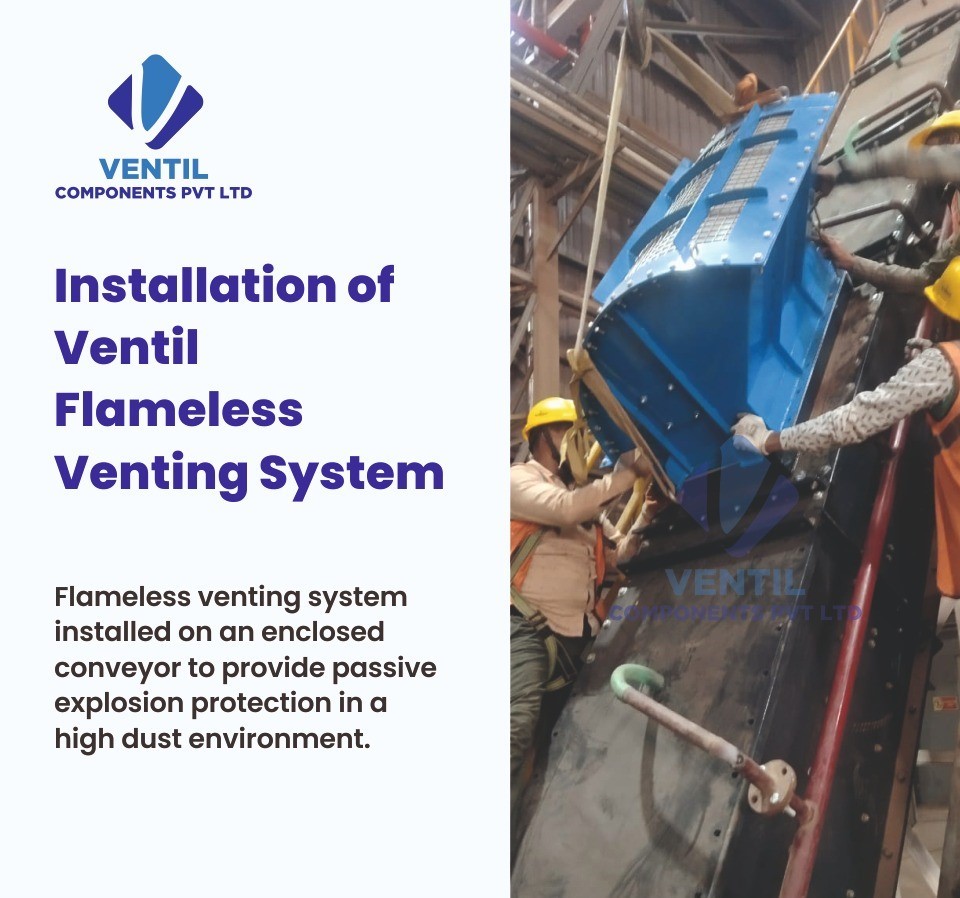
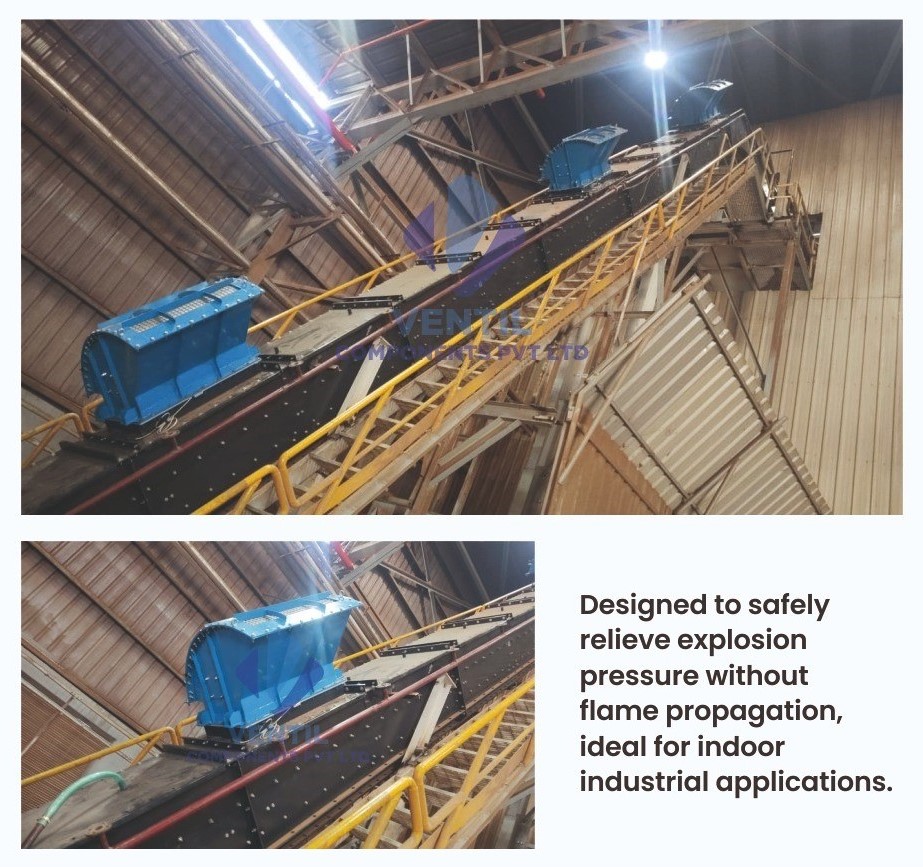
Ventil Components engineered and installed a flameless explosion venting system on an indoor enclosed conveyor handling combustible dust. The facility required explosion protection that would operate safely indoors without flame discharge or extensive structural modification.
Application: Enclosed conveyor system
Environment: Indoor industrial facility
Explosion Protection Method: Passive flameless explosion venting
Engineering Challenges Identified
During the risk assessment, the following constraints were identified:
- No safe route for external vent ducting
- Space limitations around the conveyor
- Unacceptable flame discharge risk indoors
- Desire for a passive, low-maintenance safety solution
Traditional ducted venting was eliminated due to these constraints.
Installed flameless explosion venting system on an indoor enclosed conveyor engineered by Ventil Components
Engineered Solution
Ventil designed a flameless venting solution tailored to:
- The conveyor enclosure volume
- Dust explosion characteristics (Kst, Pmax)
- Installation environment
The system was installed directly on the conveyor housing and engineered to activate instantly in the event of an explosion, relieving pressure while preventing flame propagation.
Installation Highlights
- No external ducting required
- Minimal structural modification
- Quick installation window
- Seamless integration with existing operation
Results & Safety Outcomes
- ✔ Safe indoor explosion pressure relief
- ✔ Elimination of flame and fireball risk
- ✔ Improved personnel and equipment safety
- ✔ Compliance with explosion protection practices
- ✔ No impact on production continuity
The project demonstrated how engineering-driven flameless venting provides real-world protection in indoor environments.
Compliance and Explosion Safety Considerations
Flameless explosion venting systems are engineered in alignment with recognized explosion protection principles and standards, including:
- ATEX-based methodologies (application dependent)
- EN explosion protection guidelines
- Industry-accepted dust explosion safety practices
System design considers:
- Dust explosibility parameters
- Enclosure volume
- Operating conditions
- Installation constraints
Correct sizing and application are critical to effective protection.
Applications That Benefit Most from Flameless Venting
Ideal Indoor Applications
- Enclosed belt conveyors
- Chain conveyors
- Screw conveyors
- Indoor bucket elevators
- Transfer points in pneumatic conveying systems
Industries
- Food and beverage
- Pharmaceuticals
- Chemicals
- Plastics
- Metal powders
- Bulk solids handling
Where flame discharge is unacceptable, flameless explosion venting provides a safer alternative.
Designed to Break. Built to Protect.
In explosion protection, timing is everything. Flameless explosion vents are engineered to open at the precise moment needed relieving destructive pressure while preventing flame propagation.
For indoor enclosed conveyor systems, flameless venting is not just an alternative solution it is a future-ready safety standard.
By combining passive reliability, compact design, and proven engineering, flameless explosion venting protects people, processes, and productivity without compromise.
About Ventil Components
Ventil Components leading flameless explosion event manufacturer specializes in explosion protection and pressure relief engineering, delivering application-specific solutions including:
- Flameless explosion venting systems
- Explosion vent panels
- Rupture discs
- Pneumatic conveying safety solutions
Every solution is engineered to meet real-world industrial challenges with precision and reliability.
Need Explosion Protection for an Indoor Conveyor or Enclosed System?
Ventil’s explosion protection engineers design flameless venting solutions based on your dust explosibility data, enclosure volume, and operating conditions.
- ✔ Engineering-driven sizing
- ✔ Indoor-safe, flame-free protection
- ✔ Compliance-focused design
Contact Ventil Components Today
Frequently Asked Questions: Flameless Explosion Venting for Indoor Conveyors
Yes. Flameless explosion venting is specifically engineered for indoor enclosed conveyor systems where flame discharge is unacceptable. The system relieves explosion pressure while quenching flames, preventing fireballs, secondary fires, and hazards to personnel inside industrial buildings.
Traditional ducted venting releases flame and pressure through ducts to a safe outdoor area, which is often impractical indoors due to space constraints, back pressure, and fire risk. Flameless explosion venting installs directly on the enclosure and safely relieves pressure without external ducting or flame propagation, making it ideal for indoor conveyors.
Yes. Flameless explosion venting is a fully passive explosion protection solution. It does not rely on electrical power, sensors, control panels, or detection systems. Activation occurs instantly based on pressure rise, ensuring reliable performance even during power failure or emergency conditions.
Engineering design considers key dust explosibility parameters such as Kst value, Pmax, enclosure volume, operating pressure, and installation constraints. Correct sizing based on these parameters is critical to ensure effective pressure relief and compliance with explosion safety principles.
Flameless explosion venting is commonly applied to enclosed belt conveyors, chain conveyors, screw conveyors, and indoor transfer points. Suitability depends on enclosure design, dust characteristics, and operating conditions, which must be evaluated during a risk assessment.
No. Flameless explosion venting manages explosion pressure and flame at the protected enclosure but does not prevent explosion propagation through connected equipment. In many systems, explosion isolation measures may still be required based on process layout and risk analysis.


